Beats, scenes and shots
A project splits into beats, which carry the meaning, and shots, which make the cut — kept apart so the script and the shot list can change independently.
They are not the same thing at different sizes. Keeping them apart is what lets a script be rewritten without touching the shot list, and a shot list be reordered without rewriting the script.
Beats
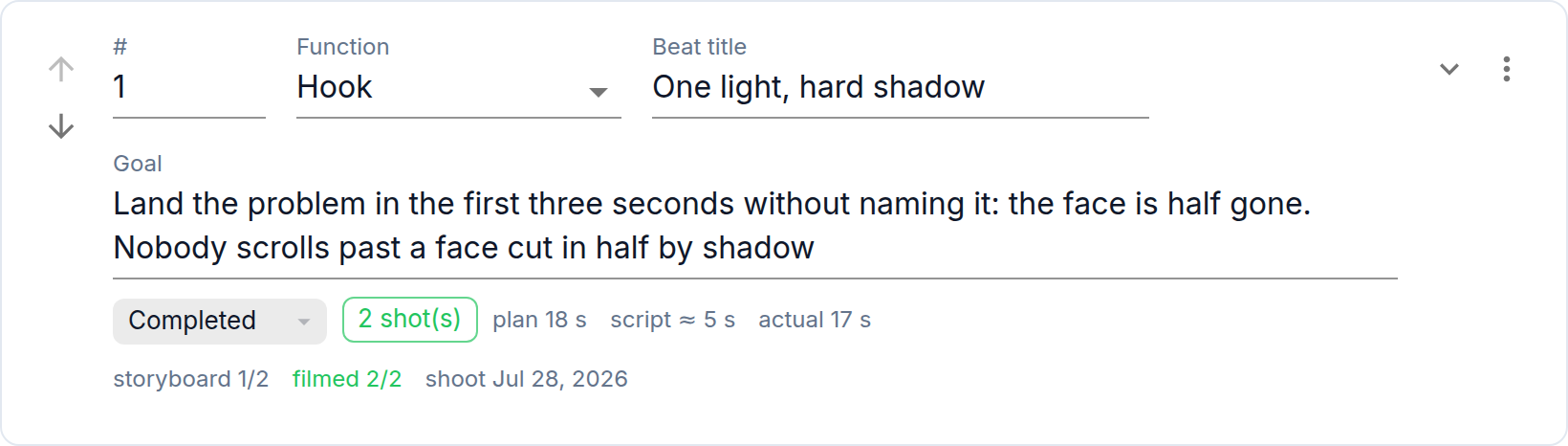
A beat is a unit of meaning: the hook, the problem, the stake, the turn, the bridge, the call to action. It answers what this stretch of the video has to do to the viewer, and roughly how long it may take to do it.
A beat carries a goal in plain words, key points as a list, a planned duration, and a beat function that names its job in the structure. It is deliberately not a container for camera decisions — those come one level down.
The beat board is where the shape of the video is argued about: reorder beats, cut one, notice the piece has three hooks and no turn.
Scenes
In a screenplay-style project the same unit is bounded by location and time of day and is called a scene. That is the only difference: the format of the project decides the word and the rule for where one unit ends, not the set of fields. A travel vlog still gets locations; a scripted short still gets key points.
The format comes from the workspace by default and can be set per project.
Shots
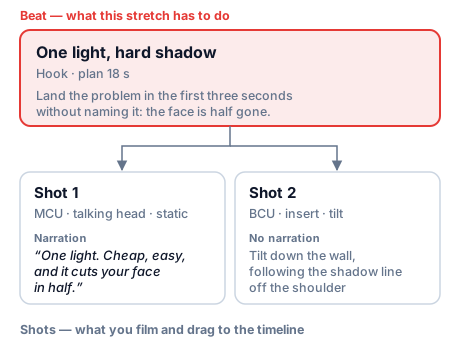
A shot is a unit of the cut: one camera setup, one line of the AV script, the thing you drag to the timeline. It holds a description, shot size, shot type and camera move, the narration text that plays over it, on-screen text and music, storyboard frames and — once you are filming — takes.
One beat becomes several shots. That is the whole point of the split: the beat says "make them recognize themselves before the number lands," and the shots say how, in order, with framing.
Where the script lives
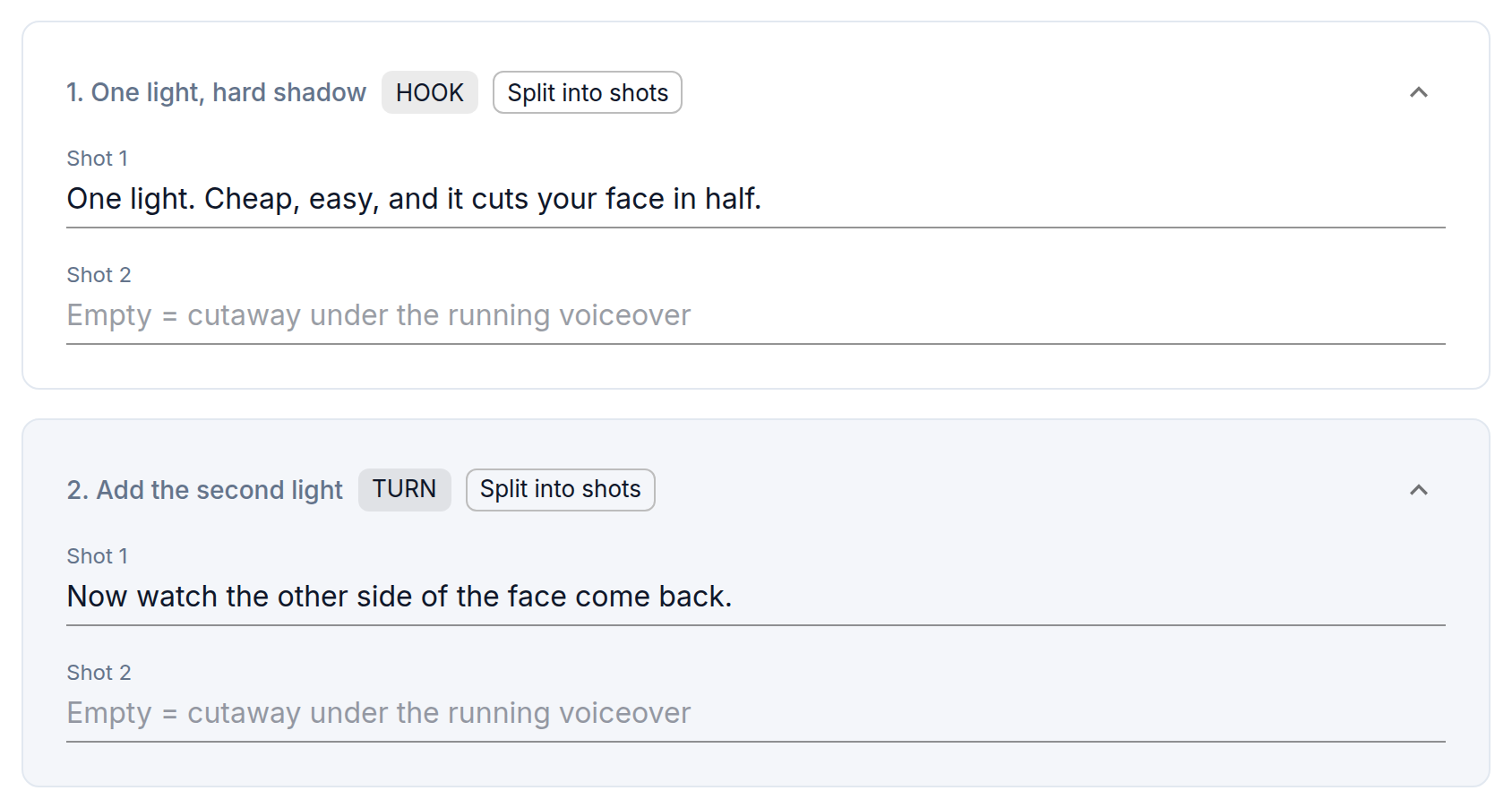
The script text lives on the shots, not on the beat, because that is where it ends up in editing — narration belongs to the frame it plays over. A beat that has not been cut into shots yet keeps its script on itself; storyboarding it, or adding the first shot by hand, moves the text into the shots.
Reading the script top to bottom is a view over the shots, assembled in order. Nothing is stored twice.
Storyboard frames
Frames attach to a shot and describe the picture in words: what is in it, the line that plays over it, and notes for the camera. They are for agreeing on the picture before the camera is set up, which is cheaper than agreeing on it after.