Words to minutes: how long will your script run?
Divide the word count by your words per minute: at 150 wpm, 1000 words run 6:40. Add the silent stretches, and you know the runtime before the shoot.
Most videos run long. You find out in the edit: the eight-minute piece comes out at eleven, the sixty-second vertical at eighty-five. Every cut at that stage throws away something you already paid for: a location, an evening of light, a take that worked. The same cut made on paper costs you one deleted sentence.
The method below needs a script, a stopwatch once, and a calculator. It works the same in a notebook, a spreadsheet or any app. Or paste your script here:
Script timer: paste a script or type a word count, pick a pace in words per minute, and get the spoken time.
The formula
Spoken time = words ÷ words per minute.
A narration of 300 words read at 150 words per minute runs two minutes. That is the whole formula. The work is in picking an honest pace and in remembering what the formula does not count.
Starting points for narration, in words per minute:
| Language | Typical narration pace |
|---|---|
| English, French, Italian, Portuguese | 150 |
| Spanish | 160 |
| German, Polish, Russian | 130 |
| Turkish | 120 |
| Japanese (counted in dictionary words) | 200 |
These are averages for calm voice-over, not for you. Conversational presenters run faster; a documentary narrator who leaves room for the picture runs slower. Treat the table as the first guess and replace it with your own number as soon as you have one.
Measure your own pace once
- Take 250–300 words of your own writing, ideally a script you have already recorded.
- Read it aloud at recording pace, the way you would deliver it to the camera, not the way you read an email.
- Time it and divide: words ÷ minutes. 280 words in 2:05 is 280 ÷ 2.08 ≈ 135 words per minute.
Do this once per voice. If two people narrate your channel, they get two numbers.
Words to minutes: quick table
Spoken time for common script lengths at three paces: 130 words per minute (a slow, careful read, and the usual pace for German, Polish or Russian), 150 (the usual narration benchmark for English) and 170 (a brisk presenter).
| Words | 130 wpm | 150 wpm | 170 wpm |
|---|---|---|---|
| 100 | 0:47 | 0:40 | 0:36 |
| 300 | 2:19 | 2:00 | 1:46 |
| 500 | 3:51 | 3:20 | 2:57 |
| 700 | 5:24 | 4:40 | 4:08 |
| 1000 | 7:42 | 6:40 | 5:53 |
| 1300 | 10:00 | 8:40 | 7:39 |
| 1500 | 11:33 | 10:00 | 8:50 |
| 2000 | 15:24 | 13:20 | 11:46 |
| 2500 | 19:14 | 16:40 | 14:43 |
Times are rounded up to the next second. The table counts the voice only. The finished video will run longer by every stretch where nobody speaks; more on that below.
Budget by beat, not by video
A single total for the whole video hides where the problem is. "Twelve minutes against a plan of ten" says nothing about what to cut. "The intro is ninety seconds against a plan of thirty" does.
So split the script into beats first, the stretches that each do one job: the hook, the problem, the turn, the payoff, the call to action. Give each beat a planned duration before you write it. Then write, count, and compare beat by beat.
The plan comes first for a reason. Written without a budget, a beat grows to fit what you know about the subject. Written to thirty seconds, it grows to fit what the viewer needs.
What the formula does not count
Words only measure the voice. A video also has stretches where nobody speaks, and on short formats they are often most of the runtime:
- Shots without narration. B-roll that breathes, an action that has to finish (a door closing, a bird taking off), a reveal held long enough to land.
- Pauses on purpose. The beat after a joke, the silence before a turn.
- Title cards and on-screen text. Text has to stay up long enough to be read, and nobody reads while the voice talks over it.
- Music-only sections. Intros, transitions, end cards.
So the full estimate for a beat is spoken time + silent time, and the silent part has to be written down as a number. Leave it implicit and it gets planned as zero.
How close is close enough
A words-per-minute estimate is approximate. Delivery changes from take to take, and a second of hesitation here and there adds up. Don't chase precision. Use thresholds instead:
| Estimate against plan | What it means | What to do |
|---|---|---|
| Within +15% | Inside the error of the method | Nothing |
| +15% to +50% | The text is too long for the slot | Trim sentences, keep the idea |
| More than +50% | The beat holds more than one idea | Split the beat or move material out |
The last row matters most. When a beat is half again over its plan, line edits will not save it. It is carrying two jobs, and one of them belongs somewhere else.
Under plan is fine as long as the silent time is accounted for. If it is not, a beat that looks "short" is usually a beat whose pictures were never planned.
Worked example: three projects from one studio
The examples come from the demo studio in CoTube: real projects at different stages, which you can open yourself (link at the end). Pace is 150 words per minute throughout. Estimates are rounded up to the next second.
A beat that has room for its action
Golden Hour is a vertical short for the phone feed with a hard cap of ninety seconds. Its first beat, "Gear check in the car", is planned at 25 seconds. The narration:
Every shot is decided before the camera is out of the bag. Three lenses on the back seat, and only one of them is coming out at the river. Pick wrong and you spend the golden hour changing glass instead of shooting.
42 words ÷ 150 × 60 ≈ 17 seconds spoken. That leaves 8 seconds of the plan for the action the beat describes: the bag open, one lens picked, the ND filter going into a pocket, the car door closing. That is not slack. It is the silent time, written down. If the text grew by another two sentences, the door would have to close under the voice, and the beat would lose its rhythm.
A beat where the voice is the minority
City Sketch is an eight-minute portrait of a city across one day, and its brief says narration stays sparse: two or three lines per block, the rest carried by sound and cutting. The beat "Market after dark" is planned at 90 seconds. Its text is 54 words, about 22 seconds.
On paper that looks like a beat 68 seconds short of its plan. It isn't. The brief asks for exactly this ratio. The check here runs the other way: if the narration crept up to 60 or 70 seconds, the film would turn into a talk-over, which the brief explicitly avoids. The estimate keeps the voice from taking over a film that is meant to be about sound.
A short where the plan held
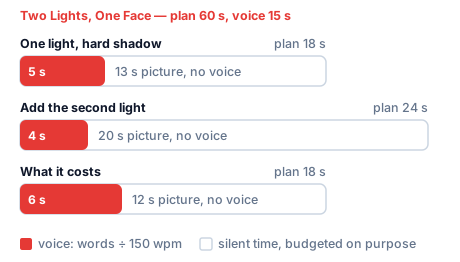
Two Lights, One Face is a sixty-second vertical that is already shot and in the edit, so the estimate can be checked against what actually happened:
| Beat | Plan | Words | Spoken | Silent (planned) | Actual |
|---|---|---|---|---|---|
| One light, hard shadow | 18 s | 11 | 5 s | 13 s | 17 s |
| Add the second light | 24 s | 10 | 4 s | 20 s | 25 s |
| What it costs | 18 s | 13 | 6 s | 12 s | 16 s |
| Total | 60 s | 34 | 15 s | 45 s | 58 s |
Fifteen seconds of voice in a sixty-second video. The rest is the picture doing the work: the shadow edge on the wall, the second panel switching on inside one continuous take, the price card. A plan made from the word count alone would have predicted a fifteen-second video. A plan that budgeted the silent time predicted sixty, and the cut came in at fifty-eight.
Template
Copy this table into a spreadsheet or under your script. One row per beat; fill Plan before you write.
| Beat | Job | Plan (s) | Words | Spoken (s) = words ÷ pace × 60 | Silent (s) | Estimate (s) | Over plan |
|---|---|---|---|---|---|---|---|
| 1 | Hook | ||||||
| 2 | Problem | ||||||
| 3 | Turn | ||||||
| 4 | Payoff | ||||||
| 5 | Call to action | ||||||
| Total |
In a spreadsheet, the spoken column is =ROUNDUP(D2 / pace * 60, 0), where pace is a cell
holding your measured words per minute. Over plan is =(G2 - C2) / C2, formatted as a percentage,
with conditional colour at 15% and 50%.
Things that throw the count off
- Numbers and symbols. "€38" is one token and three spoken words ("thirty-eight euros"). "1978" is three. Count numbers the way they are said.
- Abbreviations. "f/2.8" or "ISO 1600" are short on paper and long out loud.
- Lists. Spoken lists slow down; people pause between items without noticing.
- Quotes and on-screen text read aloud. They are often delivered slower and with emphasis.
- Script edits after the count. Re-count after every rewrite. The estimate is only as fresh as the last version of the text.
None of these needs a correction factor. Count honestly, measure your own pace, and keep the 15% margin. The point is not to predict the runtime to the second, but to find the beat that is twice its plan before you shoot it.
Common questions
How much is 1000 words in minutes?
About 6 minutes 40 seconds at 150 words per minute. At a slower 130 wpm it is 7:42, at a brisk 170 wpm 5:53. Add the silent stretches on top to get the length of the video.
Can I speak 1000 words in 5 minutes?
Only at 200 words per minute, which is fast for narration. Most voices land between 130 and 170 wpm, so 1000 words take 6 to 8 minutes. For a five-minute slot, plan 650–850 words.
How many words is a 10-minute speech?
About 1500 words at 150 words per minute, 1300 at 130 and 1700 at 170. For a ten-minute video, subtract the stretches without narration first, then turn the remaining minutes into words.
Is speaking 150 words per minute good?
Yes. 150 wpm is the usual benchmark for English voice-over and podcasts: clear, unhurried, easy to follow. Your own pace still matters more than the benchmark, so measure it once (see above).
Is 200 wpm speaking too fast?
For narration, usually yes. At 200 words per minute the listener keeps up with the words but not with the picture, and there is no room for pauses. It can work for a quick, energetic presenter on a short video, but plan the script at your measured pace, not at your fastest.
In CoTube
The beat board shows this estimate next to each beat's plan as you write: the number of seconds the text will take at the project's speech rate, highlighted when it runs more than 15% or 50% over. The speech rate is a project setting with a starting value per content language. Set your own once you have measured it. How beats, shots and their timing fit together is in the guide: Beats, scenes and shots. The three projects above are in the demo, no sign-up needed.