Camera shot types: shot sizes and angles explained
The nine shot sizes from extreme wide to extreme close-up, the camera angles, and how to choose them shot by shot, with examples and a cheat sheet.
A shot is three decisions: how much of the subject the frame holds, where the camera stands relative to it, and what the shot is for. Most lists of "types of shots" mix the three into one long list of twenty names. Kept apart, they are easier to remember and much easier to use: you pick one size, one angle and one purpose for every shot, and a column for each in your shot list keeps you from forgetting the choice.
Shot sizes
Shot size is measured against a person: where the bottom edge of the frame cuts the figure. The scale below is the one used on film sets and in production software, ordered from the widest to the closest.
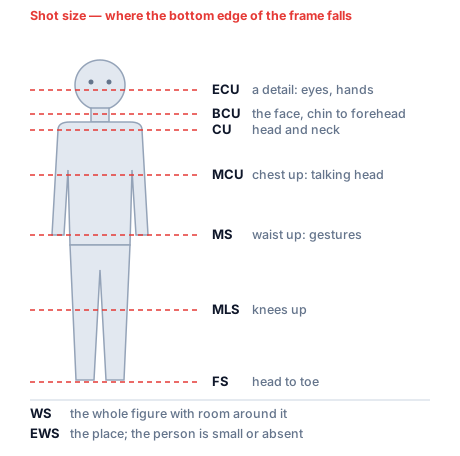
| Short | Name | What the frame holds | Use it for |
|---|---|---|---|
| EWS | Extreme wide shot | The place; a person is tiny or absent | Scale and location, the opening of a sequence |
| WS | Wide shot (long shot) | The whole figure with room around it | A person in their environment |
| FS | Full shot | Head to toe, little space around | Posture, movement, a whole action |
| MLS | Medium long shot | Knees up (the "cowboy" shot) | A step closer while keeping the body |
| MS | Medium shot | Waist up | Explaining, gestures, most dialogue |
| MCU | Medium close-up | Chest up | The default talking head and interview |
| CU | Close-up | Head and neck | Emotion, emphasis on the speaker |
| BCU | Big close-up | The face, chin to forehead | Maximum emotion, a reaction |
| ECU | Extreme close-up | A detail: eyes, hands, a texture | One thing the viewer must not miss |
For objects, the same idea holds: a wide shot shows the object in its place, a close-up fills the frame with it, an extreme close-up shows one part of it.
The scale only applies to things a camera films. A screen recording, a title card or an animated graphic has no size in this sense; leave the column empty rather than guessing.
The five basic sizes
If nine is too many to start with, five cover most videos: wide, full, medium, close-up and extreme close-up. The rest are steps between them, useful once you notice that your medium shot is "a bit too far" or your close-up "a bit too tight".
Camera angles
The angle is the camera's height and tilt relative to the subject. It is independent of size: a close-up can be shot from above or below, and the two read differently.
| Angle | Where the camera is | How it reads |
|---|---|---|
| Eye level | At the subject's eye height | Neutral; the viewer meets the subject as an equal |
| High angle | Above the subject, looking down | Smaller, weaker, observed; also good for showing a layout |
| Low angle | Below the subject, looking up | Bigger, stronger, imposing; makes ordinary things monumental |
| Overhead (top-down) | Straight above, looking down | A map or a plan: desks, food, hands at work |
| Dutch angle | Tilted on its axis | Unease, something is off; tiring if overused |
Two more terms come up often. A worm's-eye view is an extreme low angle, from the ground. A bird's-eye view is an extreme high angle, from far above; drones made it cheap, which is why it now opens half of all travel videos.
Eye level is the default for a reason: it is the angle that does not comment. Every other angle says something about the subject, so use it when you mean it.
Shot types by purpose
Size and angle describe the frame. The purpose describes the job the shot does in the cut. These are the purposes worth having as a column:
- Establishing. Puts the viewer in the place at the start of a scene. Usually wide or extreme wide.
- Talking head. The presenter speaking straight to the camera. Usually a medium close-up at eye level. Film dictionaries leave it out, because actors do not look into the lens; on YouTube it is the main shot.
- Over the shoulder. The camera behind one person, looking at another or at what they look at. Dialogue, interviews, a person at work.
- Two shot. Two people in the same frame. Shows a relationship without cutting between them.
- Point of view (POV). What a person sees, from their position.
- Insert. A close detail cut into the action: hands, a screen, a label, a price.
- B-roll. Footage that runs under the narration to illustrate it and cover the cuts.
How to choose a size for each shot
- Change size on every cut. Two consecutive shots of the same size and angle read as a jump: the subject seems to twitch in place. Move at least two steps on the scale, say from a wide shot to a medium, or from a medium to a close-up. If the size has to stay, change the angle.
- Open wide, close on a detail. A sequence that starts with an establishing shot and ends on an insert gives the editor a clean way in and out, and gives the viewer the place before the details.
- Closer means more important. A size is a statement about attention. Cut to a close-up when the viewer has to read a face or a detail, not because the previous shot ran long.
- Wider means context. If the viewer is lost, they need a wider shot, not more narration.
- Talking heads: pick one size and a second one. A single medium close-up for the whole video forces jump cuts at every edit. A second size, a close-up from the same position or a second camera, turns those cuts into size changes.
Example: five shots from a short documentary
The Last Ferry is a ten-minute film about the final week of an eighty-year-old river crossing, from the demo studio in CoTube. Its three beats are boarding, the crossing and the walk ashore. These are five of its shots, in cut order. The project has no angle field (see the end of the article), so the angle column is read from the shot descriptions:
| Shot | Size | Angle | Purpose · move | Why this size |
|---|---|---|---|---|
| Ramp and the queue | MLS | Eye level | Establishing · dolly in | The queue and the terminal behind it, close enough to see faces |
| Ferryman and the last passenger | MS | Eye level | Two shot · static | Both at the rail, neither looking at the other: the relationship is the shot |
| Over the rail, wake | MS | High angle | POV · pan | The crossing from a passenger's position, looking down at the water |
| A hand on the rail | ECU | Eye level | Insert · static | Knuckles and rust, held for the length of the crossing |
| Terminal from above | EWS | High (drone) | Establishing · drone | The building going dark block by block: the end of the place, not of a person |
Each beat opens on its widest shot: the ramp for boarding, the view over the rail for the crossing, the terminal for the end. The two neighbouring medium shots do not jump, because the angle changes between them: a two shot at eye level, then a passenger's view looking down. The smallest step, from the dolly to the two shot, works because the dolly has already carried the viewer in. The only extreme close-up comes in the middle, where the film slows down, and the widest shot of all opens the last beat: the ending belongs to the place, not to a person.
Cheat sheet
Copy this into your shot list as three columns, and fill one value in each for every shot.
| Size | Angle | Purpose |
|---|---|---|
| EWS · WS · FS · MLS · MS · MCU · CU · BCU · ECU | Eye level · High · Low · Overhead · Dutch | Establishing · Talking head · Over the shoulder · Two shot · POV · Insert · B-roll |
How to build the list itself, from beats to numbered shots, is in How to make a shot list.
Common questions
What are the 5 basic camera shots?
Wide, full, medium, close-up and extreme close-up. Together they cover most videos: the wide shows the place, the full and medium show a person and what they do, the close-up and extreme close-up show what matters.
What is a medium shot?
A medium shot frames a person from the waist up. It shows the face and the hands at the same time, which is why most explaining, presenting and dialogue happens in it.
What is a high-angle shot?
A shot taken from above the subject, with the camera looking down. It makes the subject look smaller or more vulnerable, and it is also the practical angle for showing a layout, a crowd or a table.
What is a low-angle shot?
A shot taken from below the subject, with the camera looking up. It makes the subject look bigger and more imposing, which is why it is used for heroes, buildings and anything meant to feel powerful.
How many camera angles are there?
Five are in common use: eye level, high, low, overhead and Dutch. Worm's-eye and bird's-eye are the extreme versions of low and high. Lists of "12 shots and angles" usually mix angles with sizes; kept apart, they are five angles and nine sizes.
In CoTube
Every shot has a size on the same nine-step scale, a type (establishing, talking head, over the shoulder, two shot, POV, insert, B-roll, plus screen recording, graphic, animation, title card and stock footage) and a camera move. The angle has no field of its own yet, so it goes into the shot's description. How shots sit under beats is in the guide: Beats, scenes and shots. The Last Ferry is in the demo, no sign-up needed.