How to plan a solo shoot day: a shooting schedule for one
A shooting schedule for one person: order shots by light and setup instead of by script, and fit the day into the hours you really have.
On a film set, somebody else watches the clock, somebody else carries the second lens, and somebody else notices the light is going. Alone, or with one other person, all of that is you, on top of operating the camera. Every lens change, battery swap and tripod move comes out of the same few hours, and nobody is there to say "we have twenty minutes left, drop the pan".
The plan does that job. Written the evening before, it decides what gets shot first, what gets dropped if time runs out, and when to stop setting up and start rolling. Below is how to build one from a shot list, with any tool or none.
Step 1. Write down what you do not control
Before ordering a single shot, list the constraints that will not move for you:
- Light. Sunrise and sunset times for the date and place, and the window you actually want. "Golden hour" is not an hour on the clock; it is the stretch before sunset when the light is low and warm, and it is shorter than you expect.
- Access. When the location opens, when it gets busy, when someone starts asking about your tripod. A square that is free at dawn can be off-limits by nine.
- Permits. Written permission, its hours, and what it allows: some venues allow handheld but not sticks.
- Weather. The forecast, and what would make the day pointless (fog over a view, rain on a sunset).
- Your own limits. How many hours you can operate well, and how far you have to travel.
These are the walls of the day. Everything else gets arranged inside them.
Step 2. Rank the shots: irreplaceable first
Go through the shot list and mark each shot:
- Must. Without it the video does not work: the hook, the payoff, the frame the whole trip exists for.
- Should. It makes the cut better, and the edit survives without it.
- Nice. Shoot it if there is time.
Then, inside the musts, put first whatever cannot be repeated: light that happens once, an event on its own schedule, a location you will not get back. A close-up of your hands can be reshot at home next week. The sun touching the water on this date cannot.
This is the single most important decision on the plan, because it is the one you will not have the calm to make on location.
Step 3. Group by setup, not by script order
The cut runs in script order. The day should not. Moving the camera, changing a lens or rebalancing a gimbal costs minutes each time, and alone those minutes are pure loss: nothing else is happening while you do it.
So group shots by what they share:
- Location and direction. Everything facing west from this spot, then everything facing east.
- Rig. All the tripod shots together, then all the gimbal shots, then handheld.
- Lens. Inside one rig, all the 24mm shots, then all the 35mm.
The result often looks absurd against the script: the last shot of the video gets filmed first, the opener in the middle. That is normal. The shot numbers keep the cut order; the plan only decides the filming order.
Light overrides grouping. If two shots share a setup but need different light, light wins and you pay for the extra setup.
Step 4. Put a time on every shot
For each shot estimate setup + takes:
- Setup: getting to the position, the rig built, framing and exposure set. For a new position alone, think in quarter hours, not minutes. A shot on the same tripod with a new framing is much less.
- Takes: the shot's duration times the number of takes you expect, plus resets between them. Anything with movement (a gimbal walk, a pan with a passing subject) needs more takes than a locked frame.
If you have never measured yourself, guess, and then check your guesses against the clock on the day. After two or three shoots you will have real numbers, and they will be larger than the guesses.
Add the times up. If the total is bigger than the window, the plan already tells you which shots to drop: the lowest-ranked ones, starting from the bottom. Make that decision now, not when the light is going.
Step 5. Plan the backup
Two things to decide in advance:
- A backup day, if the shot depends on weather. Hold it, and decide when you release it ("two days before, if the forecast holds"). Otherwise it stays half-held in your calendar forever.
- A fallback location, if access might fail. Check what the fallback needs: notice, a name on a list, a different time.
And one thing to accept: some days have no second chance. If the event happens once, the plan for it is one pass at everything that matters, in rank order, with no rehearsal assumed.
Step 6. Derive the bag from the plan
Pack from the plan, not from habit. Go down the shot list and write what each shot needs: lenses, filters, the gimbal, the heavier tripod head, spare batteries for a long locked shot, a rain cover. Anything not on that list stays home. Alone, every extra kilo is carried by the operator.
Shooting schedule example: an evening by the river
Golden Hour is a vertical short from the demo studio in CoTube: one riverside spot, the last forty minutes of light, under ninety seconds in the cut. The evening is planned for two people, a director and a camera operator. That is as close to solo as it gets, and the plan has to work the same way, because there is nobody to hand anything to.
The walls.
- Location: a long promenade facing west across the water. Wind picks up after sunset, so the heavier tripod head goes in the bag.
- Light: sunset at 21:05. The window that matters is roughly 20:25 to 21:05.
- Call 18:30, on location by 19:00 to find the reflection line before the light moves. Wrap 21:30.
- Weather: clear on the day. A backup evening is held for the next day, when fog is expected, and released two days before if the forecast holds.
- Fallback: a rooftop terrace with a western view, if the promenade bans tripods. It needs a week of notice and a name on the residents' list, so it has to be arranged before anyone knows it is needed.
The ranking.
| Shot | Rank | Why |
|---|---|---|
| Horizon over the water: sun disc just above the far bank, locked off | Must, irreplaceable | The frame the trip exists for. If it does not stop the scroll, nothing later will |
| Drone rise from the water to the skyline, ending on the reflection path | Must, irreplaceable | The brief's opener. One rehearsal and two takes, over water only |
| Silhouettes on the bank: two people backlit, final frame held four seconds | Must | The payoff: a person back in the frame so the light has a subject |
| Sun path on the river: gimbal move along the bank | Should | Bridges the static frames |
| Slow motion on the water | Nice | Only if the drone does not need the same fifteen minutes of light |
The last row is the plan doing its real job. The brief already settles a conflict nobody would want to argue about at 20:50: slow motion and the drone want the same light, and the drone wins.
A day sheet for that evening. The ranking and the walls are from the project; the times are the plan built from them.
| Time | Shot | Setup | Notes |
|---|---|---|---|
| 19:00 | Scout | Walk the bank | Find the line where the reflection path will fall at 20:45 |
| 19:30 | Drone rehearsal | Drone | Over water only; check the end frame lands on the reflection, not the buildings |
| 20:00 | Horizon over the water | Sticks, 24mm, ND1000 | Set and framed before the window opens; bracket if the sky clips |
| 20:25 | Horizon: roll | Same | The window opens; the frame is already waiting |
| 20:40 | Drone, take 1 and 2 | Drone | Two takes, no third |
| 20:50 | Silhouettes on the bank | Sticks | Backlit; hold the last frame four seconds |
| 21:00 | Sun path on the river | Gimbal, 35mm | If the silhouettes are in the bag |
| 21:05 | Slow motion on the water | Gimbal | Only if anything is left |
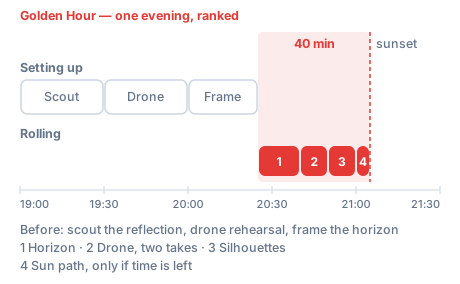
Notice what the sheet does: the most important frame is set up before its light arrives, so the best minutes are spent rolling, not framing. The shot that needs the most retakes (the gimbal walk) sits at the end, where losing it costs least.
Two lessons from days that did not go to plan
The same studio's records include two days that show what the plan is for.
The mist left early. A dawn shoot on a city square was planned around low mist. It cleared by seven, earlier than forecast, and the mist wides were gone. The fix is not a better forecast; it is ranking. The perishable shot goes first in the window, before anything that will still be there in an hour.
There was no second day. A documentary about the last week of a ferry crossing had one evening: the final service. The rehearsal crossing, planned three days earlier, was cancelled by the operator for weather, and with it the only chance to block the ramp move in advance. The plan for the real evening was therefore one pass at everything, ranked, with a drone shot noted as "one flight, two batteries; the lights go out on their own schedule". When the event will not repeat, the plan has to assume it gets one attempt at each shot.
Template: one-day shooting schedule
One row per block of time. Write the walls at the top, the ranked shots below, then fill the sheet.
Walls: location · access hours · sunrise / sunset · window wanted · weather · backup day and release date · fallback location and what it needs.
| Time | Shot (No.) | Rank | Setup (rig · lens) | Est. (setup + takes) | Why now | If late |
|---|---|---|---|---|---|---|
| Must | ||||||
| Must | ||||||
| Should | Drop | |||||
| Nice | Drop |
Bag: derived from the Setup column. Nothing else.
Common questions
What is a shooting schedule?
A shooting schedule is the plan of a shoot day: which shots are filmed when, in what order, and at which setup. It is ordered by light, location and camera position, not by the script, so it differs from the shot list. On a big production it covers many days; shooting alone, it is usually one sheet for one day.
What is a typical filming schedule?
A professional crew works a 10–12 hour day. Alone, the limit is not the clock but your own focus and the light: plan only the hours you can operate well, put the irreplaceable shots in the best window, and rank the rest so you know what to drop when time runs out.
Can you show an example of a shooting schedule?
Yes: the example above plans a real evening shoot by a river, with the light window, ranked shots, setups, timing and a backup plan. The template gives the same sheet empty, ready to fill.
In CoTube
A project set to Shooting appears on Today with its whole shot list, beat by beat. Shots open in whatever order the light and the location allow, and each keeps its beat, so the story is still in one piece for the edit. Shooting mode on the phone shows each shot's narration, framing, lens and location, and logs takes with their notes. A shoot day as its own plan (a date, a place and the shots assigned to it) is not in the app yet, so for now the day sheet above lives next to it. How shooting works today is in the guide: Shooting. The Golden Hour project is in the demo, no sign-up needed.